Is VR cricket good for batting practice?
VR cricket is a useful supplement to real batting practice, not a replacement. Research suggests a VR batting simulator captures real differences in skill, such as footwork and scoring rate, and can put you under pressure safely. It's good for reading length, moving your feet, shot selection and getting lots of balls in. It can't give you the feel of a hard ball off the pitch or the physical work of a long innings.
What the research says
There isn't much research on VR cricket yet, and some of the claims online can't be traced to a study. These are the findings we could check:
VR batting reflects real batting skill
A 2022 peer-reviewed study from Ulster University and colleagues built a VR cricket batting simulator and tested it with 28 male cricketers of higher and lower skill (study). The more skilled batters scored at a significantly higher run rate in VR and placed their feet correctly more often, which the authors read as better anticipation. In other words, the simulator showed the kind of difference you would see in a real net.
VR can put you under pressure
The same study added a high-pressure condition. Batters' anxiety went up significantly, but their batting didn't get significantly worse. For practice, that matters: VR can recreate some of the stress of a match situation in a safe, repeatable way.
Evidence from baseball
Baseball is further ahead. A 2019 study presented at IEEE VR found that a group who practised batting in VR for ten days ended up batting about as well as a group who practised the traditional way (paper). The authors called the results preliminary, and baseball isn't cricket, but it points the same way.
Be wary of big numbers. You'll find claims online that VR improves batting by a fixed percentage. We couldn't find the studies behind them. The honest summary is: promising, small studies, more research needed.
What VR practice is good for
- Reading length early. You pick up the ball from the bowler's hand and decide forward or back, ball after ball.
- Footwork. The research above suggests foot movement in VR tracks real skill. You can drill it without a bowler.
- Shot selection. Facing bowlers who work to a plan, changing line and length over by over, makes you choose the right shot rather than the favourite one.
- Volume. Hundreds of balls in a session, in your living room, any time, any weather.
- Pressure. A target to chase, three wickets in hand, a leaderboard: enough to make your hands tighten.
- Spin and swing recognition. If the ball's flight is simulated (swing, seam, drift and turn), you can practise reading movement you rarely see in the nets.
What VR can't do
- The impact. There's no ball hitting the bat. Controller vibration tells you where you hit it, but it isn't the jar of a hard ball.
- The pitch. Real pitches vary in pace and bounce in ways a game only approximates.
- The physical load. Running between the wickets, batting for hours in pads and a helmet: VR doesn't train that.
- Every tracking glitch. If the headset briefly loses the controller mid-shot, the bat goes wrong. Good games reduce this; two controllers on the bat help a lot.
How to get the most out of VR batting practice
- Use a real batStrap the controller to your bat so your grip, weight and swing match the nets. See how to use a real cricket bat in VR.
- Choose a physics-based gamePractice only transfers if the ball behaves like a cricket ball: swing, seam and spin that move it, a sweet spot that rewards the middle. See the best VR cricket games.
- Work on one thing at a timePick a bowler type in the nets (say, a left-arm seamer angling across you) and face nothing else for a session.
- Look at the dataWagon wheels and sweet-spot maps show where you score and how often you middle it. Watch the replays of your dismissals.
- Then go to the real netsTake what you worked on to real balls. VR gets you the reps; the nets prove them.
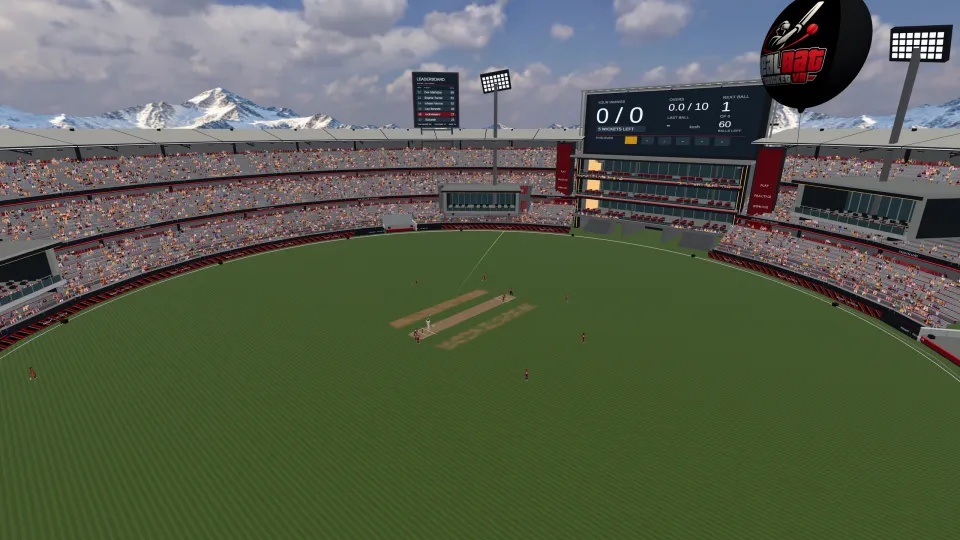
How RealBat Cricket VR is built for practice
We built RealBat around the things that make practice transfer:
- The ball's flight is worked out 240 times a second, with drag, swing and Magnus-effect spin.
- The sweet spot comes from the bat's weight and shape. The middle, the edge, the toe and the handle each play differently.
- The Nets let you choose the bowler (pace, swing, seam, off-spin, leg-spin or left-arm) and face as many balls as you want, then replay any shot from any angle.
- Auto-fire ends with your wagon wheel and sweet-spot map.
- Strap a controller (or two) to your own bat and lock it to an outline once.
Get some balls in tonight
The free demo puts you in the nets in your Quest browser: no install, no sign-up.
In your Quest: open the Browser and go to rbcvr.com.
Questions
Can VR cricket improve my batting?
It can help with reading length, footwork, shot selection and handling pressure, and research shows VR batting reflects real skill. Use it alongside real nets, not instead of them.
Is VR cricket realistic?
The best games simulate the ball's flight (swing, seam and spin) and give the bat a real sweet spot. None can recreate the impact of a hard ball or the variation of a real pitch.
Do professional cricketers use VR?
Some teams and academies use VR for training, especially for visual and decision-making work. The research is still small-scale.
New to VR cricket? Start with our complete guide to VR cricket.